10
I was living in a boarding-house in Ealing. The years were rolling on, or crawling on. Lower Binfield had passed almost out of my memory. I was the usual young city worker who scoots for the 8.15 and intrigues for the other fellow’s job. I was fairly well thought of in the firm and pretty satisfied with life. The post- war success dope had caught me, more or less. You remember the line of talk. Pep, punch, grit, sand. Get on or get out. There’s plenty of room at the top. You can’t keep a good man down. And the ads in the magazines about the chap that the boss clapped on the shoulder, and the keen-jawed executive who’s pulling down the big dough and attributes his success to so and so’s correspondence course. It’s funny how we all swallowed it, even blokes like me to whom it hadn’t the smallest application. Because I’m neither a go- getter nor a down-and-out, and I’m by nature incapable of being either. But it was the spirit of the time. Get on! Make good! If you see a man down, jump on his guts before he gets up again. Of course this was in the early twenties, when some of the effects of the war had worn off and the slump hadn’t yet arrived to knock the stuffing out of us.
I had an ‘A’ subscription at Boots and went to half-crown dances and belonged to a local tennis club. You know those tennis clubs in the genteel suburbs—little wooden pavilions and high wire- netting enclosures where young chaps in rather badly cut white flannels prance up and down, shouting ‘Fifteen forty!’ and ‘Vantage all!’ in voices which are a tolerable imitation of the Upper Crust. I’d learned to play tennis, didn’t dance too badly, and got on well with the girls. At nearly thirty I wasn’t a bad-looking chap, with my red face and butter-coloured hair, and in those days it was still a point in your favour to have fought in the war. I never, then or at any other time, succeeded in looking like a gentleman, but on the other hand you probably wouldn’t have taken me for the son of a small shopkeeper in a country town. I could keep my end up in the rather mixed society of a place like Ealing, where the office-employee class overlaps with the middling-professional class. It was at the tennis club that I first met Hilda.
At that time Hilda was twenty-four. She was a small, slim, rather timid girl, with dark hair, beautiful movements, and—because of having very large eyes—a distinct resemblance to a hare. She was one of those people who never say much, but remain on the edge of any conversation that’s going on, and give the impression that they’re listening. If she said anything at all, it was usually ‘Oh, yes, I think so too’, agreeing with whoever had spoken last. At tennis she hopped about very gracefully, and didn’t play badly, but somehow had a helpless, childish air. Her surname was Vincent.
If you’re married, there’ll have been times when you’ve said to yourself ‘Why the hell did I do it?’ and God knows I’ve said it often enough about Hilda. And once again, looking at it across fifteen years, why DID I marry Hilda?
Partly, of course, because she was young and in a way very pretty. Beyond that I can only say that because she came of totally different origins from myself it was very difficult for me to get any grasp of what she was really like. I had to marry her first and find out about her afterwards, whereas if I’d married say, Elsie Waters, I’d have known what I was marrying. Hilda belonged to a class I only knew by hearsay, the poverty-stricken officer class. For generations past her family had been soldiers, sailors, clergymen, Anglo-Indian officials, and that kind of thing. They’d never had any money, but on the other hand none of them had ever done anything that I should recognize as work. Say what you will, there’s a kind of snob-appeal in that, if you belong as I do to the God-fearing shopkeeper class, the low church, and high-tea class. It wouldn’t make any impression on me now, but it did then. Don’t mistake what I’m saying. I don’t mean that I married Hilda BECAUSE she belonged to the class I’d once served across the counter, with some notion of jockeying myself up in the social scale. It was merely that I couldn’t understand her and therefore was capable of being goofy about her. And one thing I certainly didn’t grasp was that the girls in these penniless middle-class families will marry anything in trousers, just to get away from home.
It wasn’t long before Hilda took me home to see her family. I hadn’t known till then that there was a considerable Anglo-Indian colony in Ealing. Talk about discovering a new world! It was quite a revelation to me.
Do you know these Anglo-Indian families? It’s almost impossible, when you get inside these people’s houses, to remember that out in the street it’s England and the twentieth century. As soon as you set foot inside the front door you’re in India in the eighties. You know the kind of atmosphere. The carved teak furniture, the brass trays, the dusty tiger-skulls on the wall, the Trichinopoly cigars, the red-hot pickles, the yellow photographs of chaps in sun-helmets, the Hindustani words that you’re expected to know the meaning of, the everlasting anecdotes about tiger-shoots and what Smith said to Jones in Poona in ‘87. It’s a sort of little world of their own that they’ve created, like a kind of cyst. To me, of course, it was all quite new and in some ways rather interesting. Old Vincent, Hilda’s father, had been not only in India but also in some even more outlandish place, Borneo or Sarawak, I forget which. He was the usual type, completely bald, almost invisible behind his moustache, and full of stories about cobras and cummerbunds and what the district collector said in ‘93. Hilda’s mother was so colourless that she was just like one of the faded photos on the wall. There was also a son, Harold, who had some official job in Ceylon and was home on leave at the time when I first met Hilda. They had a little dark house in one of those buried …

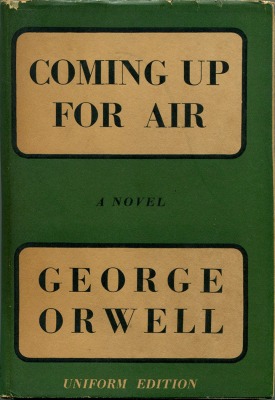
 George Orwell


















Recenze
Zatím zde nejsou žádné recenze.