5
Fishing!
Here I’ll make a confession, or rather two. The first is that when I look back through my life I can’t honestly say that anything I’ve ever done has given me quite such a kick as fishing. Everything else has been a bit of a flop in comparison, even women. I don’t set up to be one of those men that don’t care about women. I’ve spent plenty of time chasing them, and I would even now if I had the chance. Still, if you gave me the choice of having any woman you care to name, but I mean ANY woman, or catching a ten-pound carp, the carp would win every time. And the other confession is that after I was sixteen I never fished again.
Why? Because that’s how things happen. Because in this life we lead—I don’t mean human life in general, I mean life in this particular age and this particular country—we don’t do the things we want to do. It isn’t because we’re always working. Even a farm-hand or a Jew tailor isn’t always working. It’s because there’s some devil in us that drives us to and fro on everlasting idiocies. There’s time for everything except the things worth doing. Think of something you really care about. Then add hour to hour and calculate the fraction of your life that you’ve actually spent in doing it. And then calculate the time you’ve spent on things like shaving, riding to and fro on buses, waiting in railway, junctions, swapping dirty stories, and reading the newspapers.
After I was sixteen I didn’t go fishing again. There never seemed to be time. I was at work, I was chasing girls, I was wearing my first button boots and my first high collars (and for the collars of 1909 you needed a neck like a giraffe), I was doing correspondence courses in salesmanship and accountancy and ‘improving my mind’. The great fish were gliding round in the pool behind Binfield House. Nobody knew about them except me. They were stored away in my mind; some day, some bank holiday perhaps, I’d go back and catch them. But I never went back. There was time for everything except that. Curiously enough, the only time between then and now when I did very nearly go fishing was during the war.
It was in the autumn of 1916, just before I was wounded. We’d come out of trenches to a village behind the line, and though it was only September we were covered with mud from head to foot. As usual we didn’t know for certain how long we were going to stay there or where we were going afterwards. Luckily the C.O. was a bit off-colour, a touch of bronchitis or something, and so didn’t bother about driving us through the usual parades, kit-inspections, football matches, and so forth which were supposed to keep up the spirits of the troops when they were out of the line. We spent the first day sprawling about on piles of chaff in the barns where we were billeted and scraping the mud off our putties, and in the evening some of the chaps started queueing up for a couple of wretched worn-out whores who were established in a house at the end of the village. In the morning, although it was against orders to leave the village, I managed to sneak off and wander round the ghastly desolation that had once been fields. It was a damp, wintry kind of morning. All round, of course, were the awful muck and litter of war, the sort of filthy sordid mess that’s actually worse than a battlefield of corpses. Trees with boughs torn off them, old shell-holes that had partly filled up again, tin cans, turds, mud, weeds, clumps of rusty barbed wire with weeds growing through them. You know the feeling you had when you came out of the line. A stiffened feeling in all your joints, and inside you a kind of emptiness, a feeling that you’d never again have any interest in anything. It was partly fear and exhaustion but mainly boredom. At that time no one saw any reason why the war shouldn’t go on for ever. Today or tomorrow or the day after you were going back to the line, and maybe next week a shell would blow you to potted meat, but that wasn’t so bad as the ghastly boredom of the war stretching out for ever.
I was wandering up the side of a hedge when I ran into a chap in our company whose surname I don’t remember but who was nicknamed Nobby. He was a dark, slouching, gypsy-looking chap, a chap who even in uniform always gave the impression that he was carrying a couple of stolen rabbits. By trade he was a coster and he was a real Cockney, but one of those Cockneys that make part of their living by hop-picking, bird-catching, poaching, and fruit-stealing in Kent and Essex. He was a great expert on dogs, ferrets, cage- birds, fighting-cocks, and that kind of thing. As soon as he saw me he beckoned to me with his head. He had a sly, vicious way of talking:
‘‘Ere, George!’ (The chaps still called me George—I hadn’t got fat in those days.) ‘George! Ja see that clump of poplars acrost the field?’
‘Yes.’
‘Well, there’s a pool on t’other side of it, and it’s full of bleeding great fish.’
‘Fish? Garn!’
‘I tell you it’s bleeding full of ‘em. Perch, they are. As good fish as ever I got my thumbs on. Com’n see f’yerself, then.’
We trudged over the mud together. Sure enough, Nobby was right. On the other side of the poplars there was a dirty-looking pool with sandy banks. Obviously it had been a quarry and had got filled up with water. And it was swarming with perch. You could see their dark blue stripy backs gliding everywhere just under water, and some of them must have weighed a pound. I suppose in two years of war they hadn’t been disturbed and had had time to multiply. Probably you can’t imagine what the sight of those perch had done to me. It was as though they’d suddenly brought me to life. Of course there was only one thought in both our minds—how to get hold of a rod and line.
‘Christ!’ I said. ‘We’ll have some of those.’
‘You bet we f— well will. C’mon back to the village and let’s get ‘old of some tackle.’
‘O.K. You want to watch out, though. If the sergeant gets to know we’ll cop it.’
‘Oh, f— the sergeant. They ca…

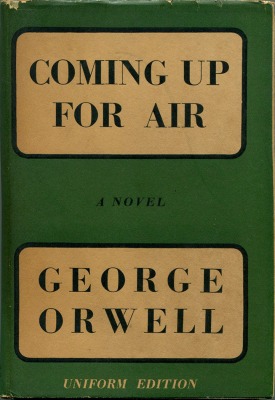
 George Orwell













Recenze
Zatím zde nejsou žádné recenze.